Before starting my one-year postgraduate study, I didn’t have a clear goal in the research direction of fashion photography, so I brainstormed and thought about all aspects related to fashion photography.
Figure 1 shows my brainstorming process.
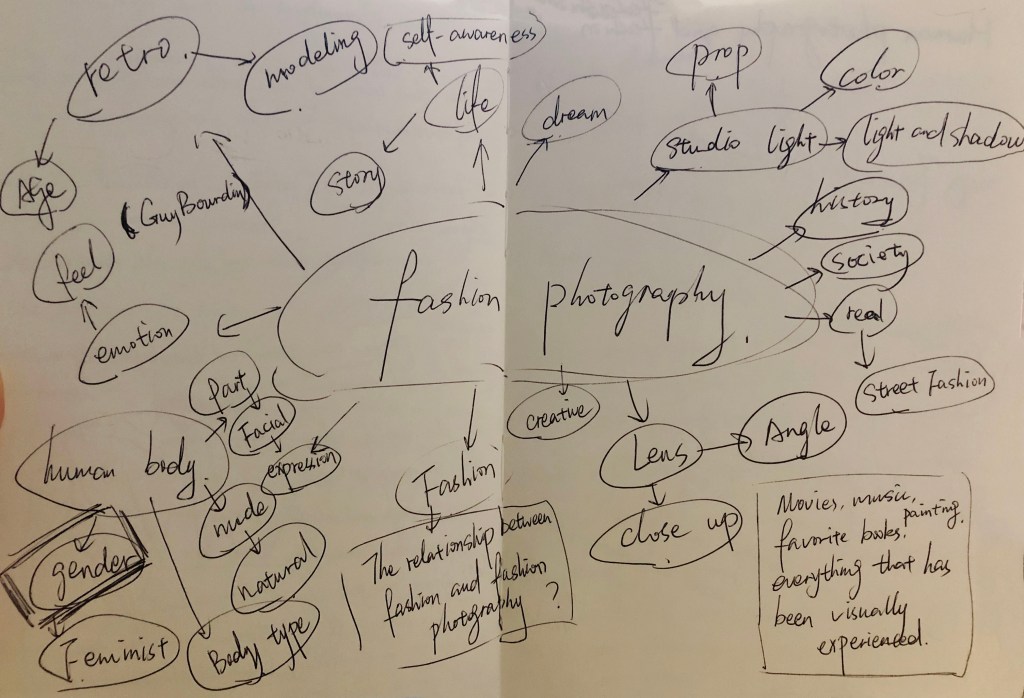
Therefore, through brainstorming, I summarized several important research directions.
- Emotion
- Retro style
- Human body
- Gender——Feminist
- Light and color
- Street Fashion
- Aesthetic and History
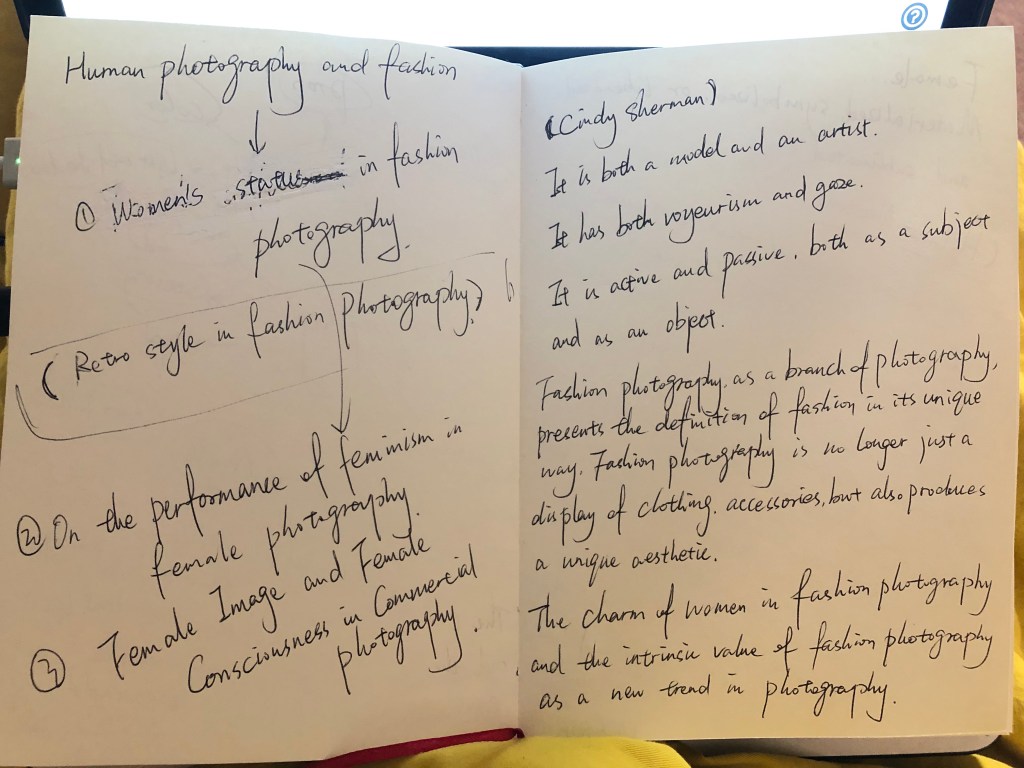
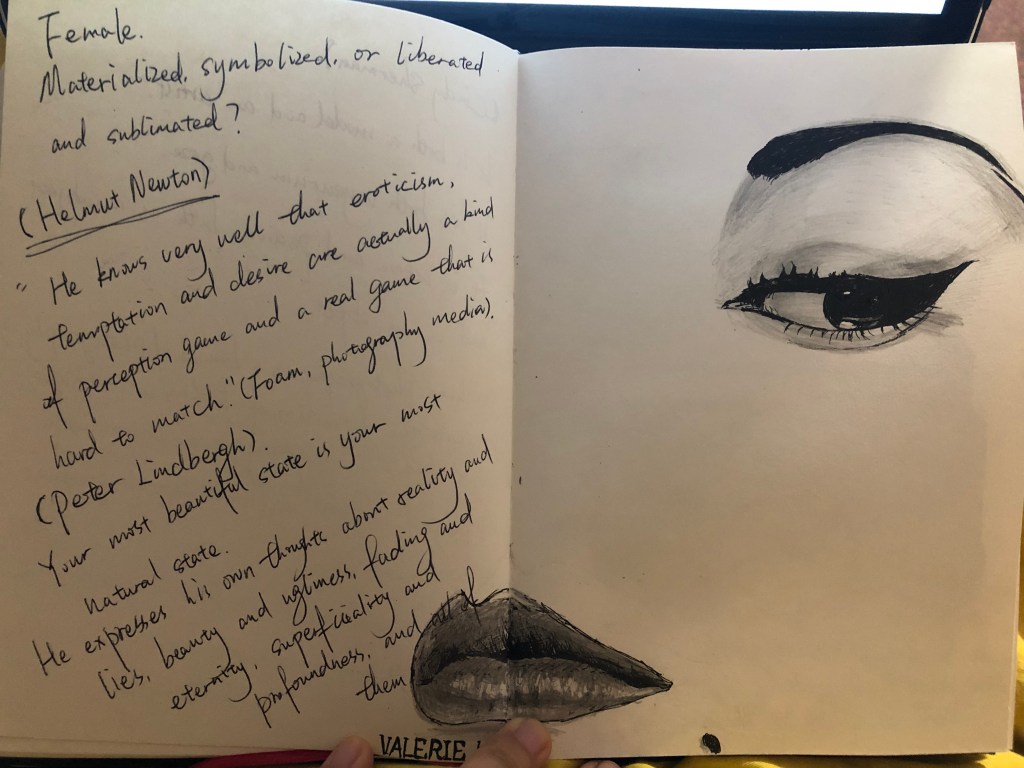
Then I did more specific research on the areas I was interested in. This includes multiple aspects.
For example, Figure 2 and Figure 3 show.
I also thought about the aesthetics of photography.
Photographic aesthetics is an important branch of photography and artistic aesthetics. It is a new subject based on photography and aesthetics to study beauty and aesthetic issues in photography.
When photography enters people’s lives, that is, the aesthetic relationship with human beings, aesthetics of photography comes into being. In the history of world photography, Ai Mosheng is recognized as the founder of photography aesthetics. Photography aesthetics is a basic task to study how to engage in the creation of photographic art and the relationship and interaction between the subject, object, ontology and receptor according to the laws of beauty. The specific contents include: the aesthetic essence and aesthetic characteristics of photographic art; photography art and reality The relationship between life and its image ingestion process; the relationship between photographic art and painting art; the form of photographic art; the development of photographic art and the photographic art concept, the genre and style of the process of change; the creation of photography art and The aesthetic character of photographic art; the aesthetic value and social function of photographic art; the psychological mechanism, process, characteristics, meaning and method of appreciation of photographic art.
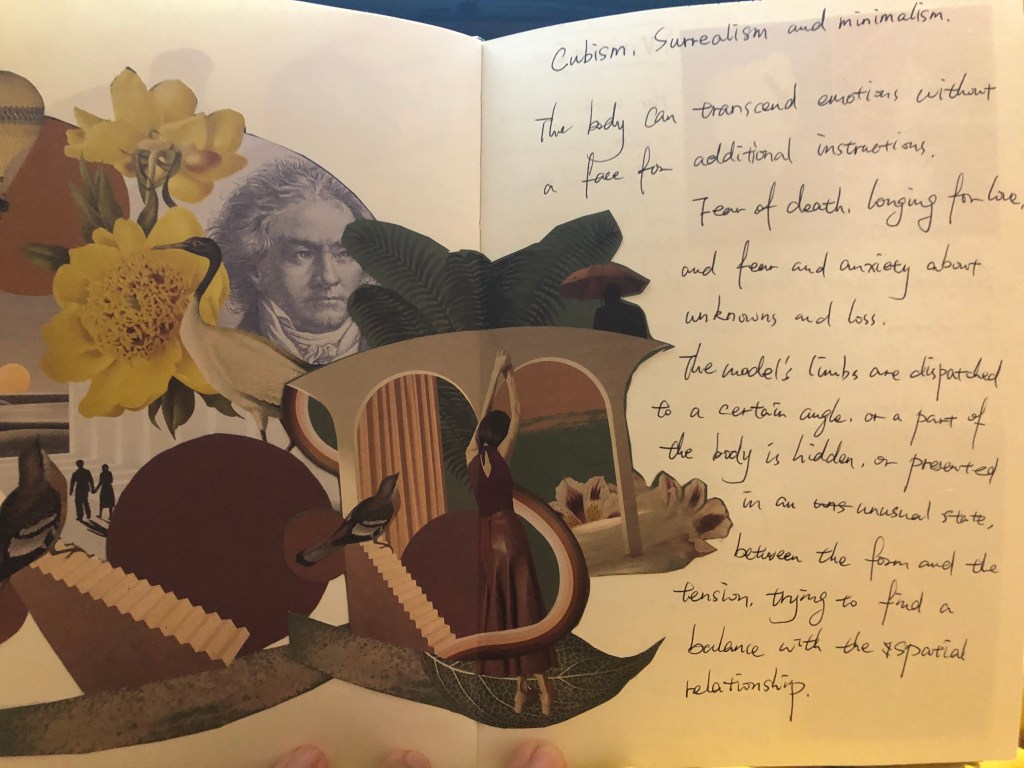
Regarding the connection between facial and emotional expression in photography, whether the face of a person affects the content expressed in the whole picture.(Figure four)
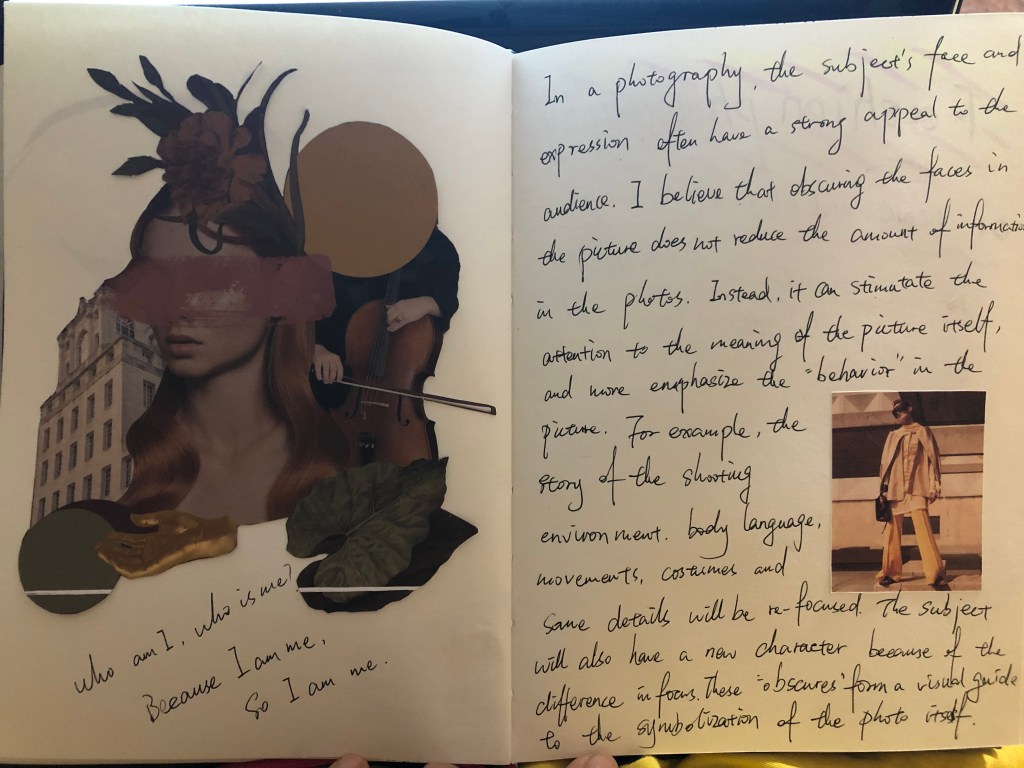
I think that in a picture, occluding the face does not reduce the information brought to us in the picture. On the contrary, it can make the viewer think about the whole picture, such as body language, environment, etc., and it can better highlight the meaning of the picture itself. So I researched this idea in more depth. (Figure five)
The first study was about the connection of the face to the whole picture.
I want to find an example to provide evidence for my statement. I collected information about photographers related to my research. Example: Ben Zank、Christopher Ryan McKenney、JunWei Sheng,etc. Among them, I found that Vivienne Sassen’s work shares a lot with what I want to study. She often hides her subjects behind tree branches, grass, corners of stairs, furniture, flying football, using strong light and dark contrasts to make them stand in the shadows, stand in front of high light backgrounds, or simply turn around. Then, she used one body to block the other, creating a ghostly double shadow, allowing the faceless body to talk and dance in the overlapping space. “Hidden” is an iconic style in Viviane’s work. In her work, more emphasis is placed on actions and behaviors than on the face.(For Vivienne Sasson’s research, I won’t explain too much here, and explain her work in more detail in other blogs.)
Based on the thinking of the face in the picture, it also caused me to think about new problems.Faces that are blocked in the picture are like a missing part of the picture, just like those fuzzy memories. When we look at photos and look back at what happened in the past, we can only remember part of the event, such as the general process of the event, one or more people in the scene, or some general location. But many of these details are missing, and we automatically filter out content that we don’t consider important. But does that content also have some residual value? So I conducted another experimental study.
Memory and Surplus value.
About leftover images and memories.
I noticed some details in the darkroom, some leftover negatives. Most of them are discarded due to people’s mistakes in shooting or processing errors, and people’s emotions and memories are also discarded.
These discarded negatives are like human memories. When we recall the past, even if we are very
Force, still can not fully recall all the memories, and finally the memory eventually fades into the last impressions over time. In the end we can remember that it may be the remaining part or it may be completely invalid. Faced with these, we can only do nothing.
I want to scan these “missing” images for observation, which may be another language of images, in order to explore their residual value.
Conclusion (thus far)
I determined that the general direction I wanted to study was about the effect of the face on the picture and the memory and residual value. But I don’t think this is the final research direction, but only as part of the research. Next, I will delve into related artists and their works in order to provide sufficient evidence for my research.
 OUTLET IN NEW